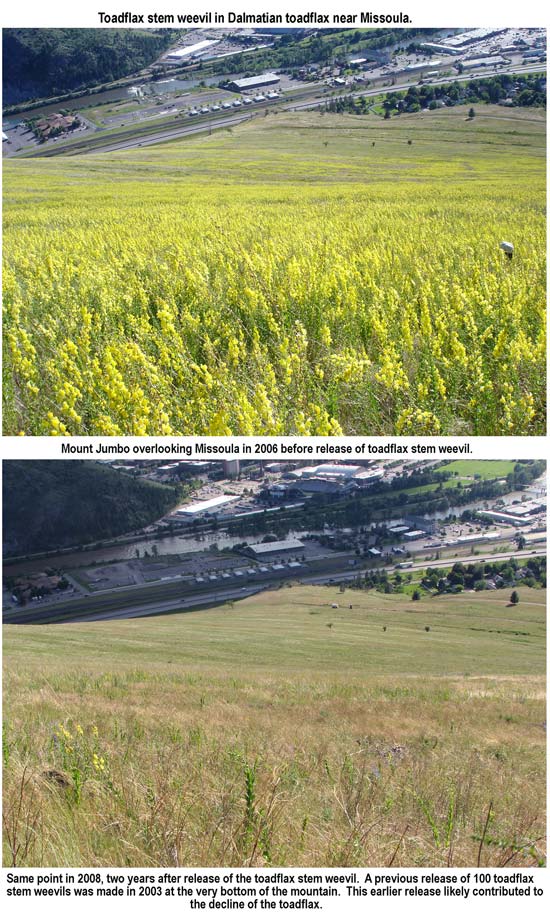
Dalmatian Toadflax Stem Weevil
Mecinus janthiniformis (formerly known as Mecinus janthinus):
This insect is having a profound impact on Dalmatian toadflax infestations. Adults feed on the foliage and flowers while larvae mine out the stem. Plants are often stunted and tops of the plant are riddled with holes caused by adult feeding. This insect flies well and seeks out new toadflax patches. It is important for landowners to know if their weed population is Dalmatian or Yellow toadflax. Mecinus janthiniformis is a very effective biocontrol against Dalmatian but not Yellow toadflax. Know which species of weed you have before investing in biocontrol.
$150 per release of 100 insects.
Available mid-May to mid- June.
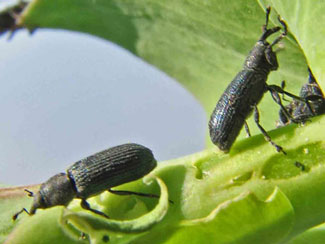
Weevils feeding on stems
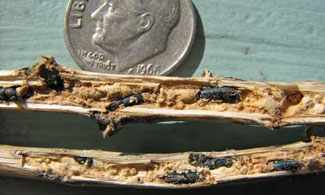
Adult weevils about to emerge from toadflax stem after over-wintering. The stem is packed with frass (insect excrement) as a result of larval feeding in the stem tissue the previous summer.
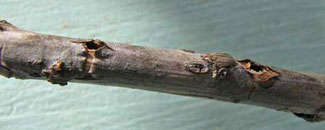
Emergence holes in toadflax stem created by adult weevils as they emerge from the stem in late spring.
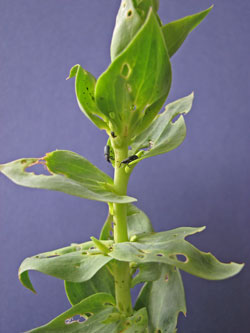
Adult feeding of the toadflax weevil creates numerous holes in Dalmatian toadflax leaves.
The Dalmatian toadflax stem weevil is approved for release in the United States by the US Department of Agriculture. It is also host specific, meaning it only feeds on Dalmation toadflax, nothing else. There is no danger of them feeding on native plants or crops. Once established on a site, the insects reproduce rapidly and spread to other weed infested areas . One release of insects can grow to over a million in just a few years. They are adapted to cold climates and do not die off in the winter. There is no need to purchase additional insects in following years. Because the insects's only source of food is Dalmatian toadflax, as the density of the weed decreases, the insect's population also decreases, a classic predator-prey relationship. Eventually the weed and the biocontrol come into equilibrium with each other at a low population in the environment. Since the insects spread to many acres and achieve permanent control of toadflax, the cost of control is very low, possibly less than a dollar per acre for a large area. This makes biocontrol a very attractive option compared to the high and recurring cost of chemical control. All of these factors make biocontrol "The Smart Choice" for control of Dalmatian toadflax.
As the old saying goes, “Montana weather is predictably unpredictable”. Since the insect’s development is dependent on the weather, that means that many years the insects are out early and unavailable early too. We always encourage folks to order their insects as early as possible in the year so you don’t miss your chance at the bugs.
Click here to see what the experts have to say in research articles and government publications.
Click here for practical information on the use of biocontrol insects.
Contact us at (406)251-4261 or (406) 552-5024 if you have questions.